Mycotoxin Testing: How to Test for Mold Toxins in the Body
If you are struggling with chronic fatigue, brain fog, headaches, sinus issues, Mast Cell Activation Syndrome (MCAS), Lyme disease, or persistent inflammation, you may wonder whether mold exposure is contributing to your symptoms.
One of the most common questions I hear is:
“Should I get tested for mycotoxins?”
Testing may provide useful information, but it is important to understand its limitations. A negative result does not necessarily rule out mold-related illness. Timing, hydration, ongoing exposure, kidney function, and individual differences in toxin metabolism and elimination can all affect mycotoxin results.[1,2]
For this reason, I interpret mycotoxin testing alongside a patient’s symptoms, medical history, environmental exposure, home testing, and other clinical findings.
What Are Mycotoxins?
Mycotoxins are toxic chemical compounds produced by certain molds under specific environmental conditions. Unlike mold spores, which are reproductive structures, mycotoxins are nonliving substances that may persist in dust and contaminated materials.[3,4]
Not every mold produces mycotoxins, and molds capable of producing them do not do so under every condition. Moisture, temperature, available nutrients, and stage of growth all influence toxin production. Therefore, detecting a mycotoxin in urine does not identify where the exposure occurred.
Mold Spores vs. Mycotoxins
- Mold spores are reproductive particles that can trigger allergies, asthma, sinus inflammation, and other respiratory symptoms.
- Mycotoxins are chemicals produced by certain molds. They may become associated with spores, fungal fragments, and dust in a water-damaged building.[3,4]
How Does Exposure Occur?
In water-damaged buildings, exposure may occur when mold spores, fungal fragments, and contaminated dust become airborne and are inhaled. Mold commonly grows on damp drywall, insulation, wood, carpeting, ceiling tiles, and other building materials.
Potential sources include:
- Roof and plumbing leaks
- Flooding or previous water intrusion
- Damp crawl spaces and basements
- Water-damaged drywall or insulation
- Contaminated HVAC systems or other heating and cooling systems such as mini splits, PTAC units, etc…
- Poorly ventilated bathrooms
- Condensation and persistently high humidity
Mold is often hidden behind walls, beneath floors, inside cabinets, or within HVAC systems. The World Health Organization and National Academies have concluded that damp indoor environments are associated with respiratory symptoms, asthma exacerbations, and other adverse health effects.[4,5] In my practice, I have seen mold completely debilitate people causing severe issues impacting every organ in the body.
Why Are Mycotoxins a Concern?
Hundreds of mycotoxins have been identified. Experimental and toxicological research suggests that certain mycotoxins can increase oxidative stress, disrupt protein synthesis, alter immune signaling, impair mitochondrial function, and affect neurological, liver, and kidney function.[3,6,7]
Not everyone exposed to the same building becomes ill. The response can be influenced by the severity and duration of exposure, immune health, underlying illness, nutritional status, and genetic susceptibility.
Certain HLA-DR/DQ haplotypes have been proposed within the Chronic Inflammatory Response Syndrome framework as susceptibility factors for prolonged biotoxin-related inflammation. Estimates that approximately one-quarter of the population carries a “mold-susceptible” pattern come primarily from this clinical framework and have not been universally validated or accepted in conventional medicine.[8]
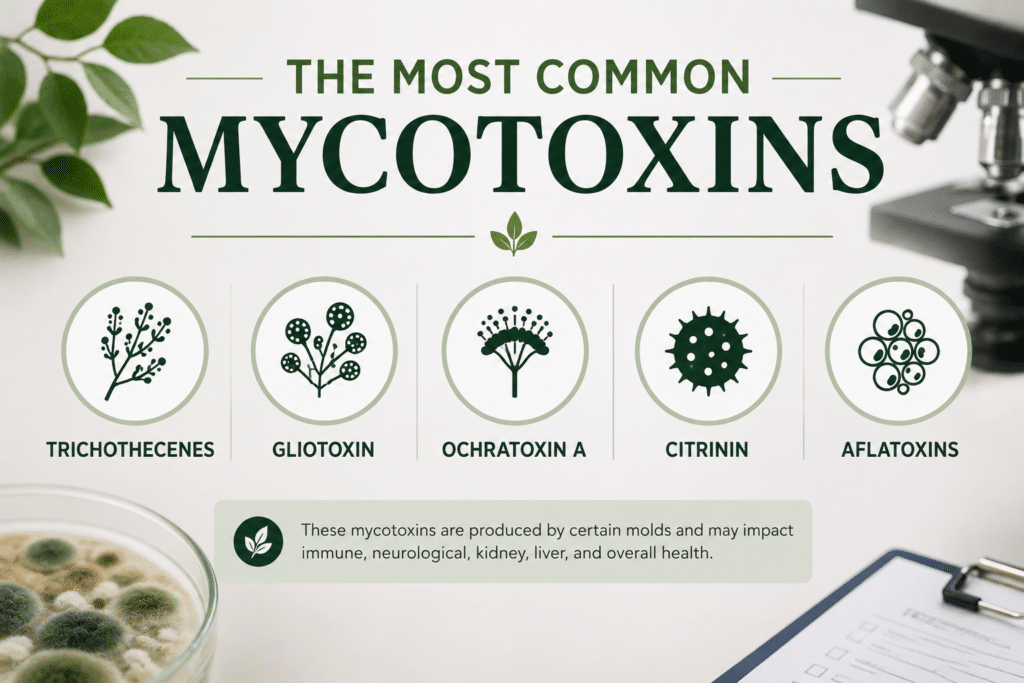
The Most Common Mycotoxins
The presence of a mold species does not necessarily mean it is actively producing its associated toxins.
| Mycotoxin | Common Mold Sources | Potential Effects |
|---|---|---|
| Trichothecenes | Stachybotrys chartarum, Fusarium and Myrothecium species | Protein-synthesis inhibition, oxidative stress, and immune or neurological effects |
| Gliotoxin | Aspergillus fumigatus | Immune suppression and oxidative stress |
| Ochratoxin A | Certain Aspergillus and Penicillium species | Kidney, neurological, mitochondrial, and immune effects |
| Citrinin | Penicillium citrinum and certain Aspergillus species | Primarily kidney toxicity |
| Aflatoxins | Aspergillus flavus and A. parasiticus | Liver toxicity; naturally occurring aflatoxins are classified as Group 1 human carcinogens |
| Zearalenone | Fusarium species | Estrogenic and endocrine effects |
| Fumonisins | Fusarium verticillioides and F. proliferatum | Disruption of sphingolipid metabolism and possible neurological effects |
| Sterigmatocystin | Aspergillus versicolor and related species | Potential liver toxicity and carcinogenicity, based largely on experimental evidence |
Who Should Consider Mycotoxin Testing?
Testing may be worth discussing with a qualified healthcare provider when persistent symptoms occur alongside known or suspected exposure to a water-damaged building.
Possible reasons to consider testing include:
- Chronic fatigue, brain fog, or memory problems
- Persistent headaches
- Recurrent sinus or respiratory symptoms
- Muscle or joint pain
- Chemical or fragrance sensitivities
- Unexplained inflammatory or neurological symptoms
- A history of substantial water-damaged-building exposure
Symptoms alone cannot diagnose mold illness, but they may indicate that a broader clinical and environmental evaluation is appropriate.
Types of Mold and Mycotoxin Testing
No single test can determine whether mold is causing a person’s illness. Different tests answer different questions:
- Urine mycotoxin tests measure mycotoxins being excreted at the time of collection.
- Environmental tests look for mold species, spores, mold DNA, or mycotoxins in a building.
- Allergy blood or skin tests assess IgE-mediated sensitivity to specific molds.
- Specialty blood tests may measure antibodies to mycotoxins, but these are different from directly measuring the toxins and have limited clinical validation.
- Specialty immune testing measures antibodies (primarily IgG and, in some cases, IgE) directed against certain mycotoxins. These tests evaluate an immune response rather than directly measuring mycotoxins in the body.
- Chronic Inflammatory Response Syndrome (CIRS) biomarkers assess inflammatory pathways proposed within the CIRS framework; they do not directly measure mold or mycotoxins.
The results are most meaningful when combined with symptoms, exposure history, environmental findings, and clinical evaluation.
Urine Mycotoxin Testing
Urine is the specimen most commonly used by specialty laboratories offering mycotoxin testing. Collection is noninvasive and can usually be completed at home.
A urine test does not measure the total amount of mycotoxin stored in the body. It measures the amount being excreted in that sample. Therefore:
- A higher level does not automatically mean a person has a greater total body burden.
- A negative result does not necessarily exclude past or current exposure.
- The test cannot identify the building or environment where exposure occurred.
Hydration, kidney function, collection timing, ongoing exposure, and individual metabolism can influence results.
Potential Advantages
- Noninvasive, at-home collection
- Measures several mycotoxins in one sample
- May provide clues about recent excretion
- May be useful for following trends when the same laboratory and collection method are used
Important Limitations
- Does not determine the source or timing of exposure
- Does not directly measure toxin stored in tissues
- Results vary among laboratories and methodologies
- Clinical thresholds predicting disease are not well established
- Results require correlation with symptoms and environmental findings
- If the body’s detoxification and elimination pathways (such as the liver, kidneys, and lymphatic system) are not functioning efficiently, mycotoxins may not be excreted effectively into the urine, which can result in lower test results than expected.
Comparing Common Urine Mycotoxin Tests
The three specialty laboratories most frequently used in integrative practice are RealTime Laboratories, MosaicDX, and Vibrant Wellness.
| Laboratory | Test Characteristics |
|---|---|
| RealTime Laboratories | Tests 16 mycotoxins, including nine macrocyclic trichothecenes; may be considered when Stachybotrys exposure is a specific concern.[9] |
| MosaicDX | Its MycoTOX Profile measures 11 urinary mycotoxins using LC-MS/MS and can be ordered alongside other functional testing.[10] |
| Vibrant Wellness | Uses LC-MS/MS and includes a broad mycotoxin assessment; mycotoxin testing can also be combined with heavy-metal and environmental-chemical panels.[11] |
There is no universally best test. I select a laboratory based on the suspected exposure, the toxins being evaluated, previous testing, clinical goals, and cost. Results from different laboratories should not be treated as directly interchangeable because the analytes, methods, reporting units, and reference ranges may differ.
Blood Testing and Mold Allergy Testing
Direct blood testing for circulating mycotoxins is not routinely used to diagnose chronic illness associated with water-damaged buildings. Some specialty laboratories, such as MyMycoLab, offer blood tests that measure antibodies (primarily IgG and, in some cases, IgE) directed against specific mycotoxins rather than measuring the toxins themselves. The premise is that persistent exposure to mycotoxins may stimulate an immune response, and these antibodies may remain detectable even when mycotoxins are no longer being actively excreted in the urine.
Allergists and immunologists more commonly use skin-prick testing or serum-specific IgE testing to evaluate mold allergy. These tests may help identify allergic sensitivity, asthma triggers, or allergic fungal disease, but they do not measure mycotoxin exposure or diagnose CIRS.
Preparing for a Urine Mycotoxin Test
Because urine testing measures excretion at one point in time, some integrative practitioners support the body’s elimination systems before testing. This may include addressing hydration, regular bowel movements, liver and bile function, kidney health, and gentle movement.
Some practitioners also use provocation before collection to encourage toxin mobilization. Suggested approaches may include:
- Glutathione
- N-acetylcysteine
- Sauna
- Light exercise or sweating, when tolerated
Patients with severe MCAS, ME/CFS, Long COVID, post-exertional malaise, neurological symptoms, or significant medical fragility may worsen with aggressive supplementation, sauna, or exercise. Preparation should be individualized and guided by a healthcare provider.
A negative result should not be interpreted as proof that mold is not contributing to symptoms. It may reflect collection timing, limited excretion, hydration, laboratory methodology, or the absence of measurable exposure. The result must be considered alongside the complete clinical and environmental picture.
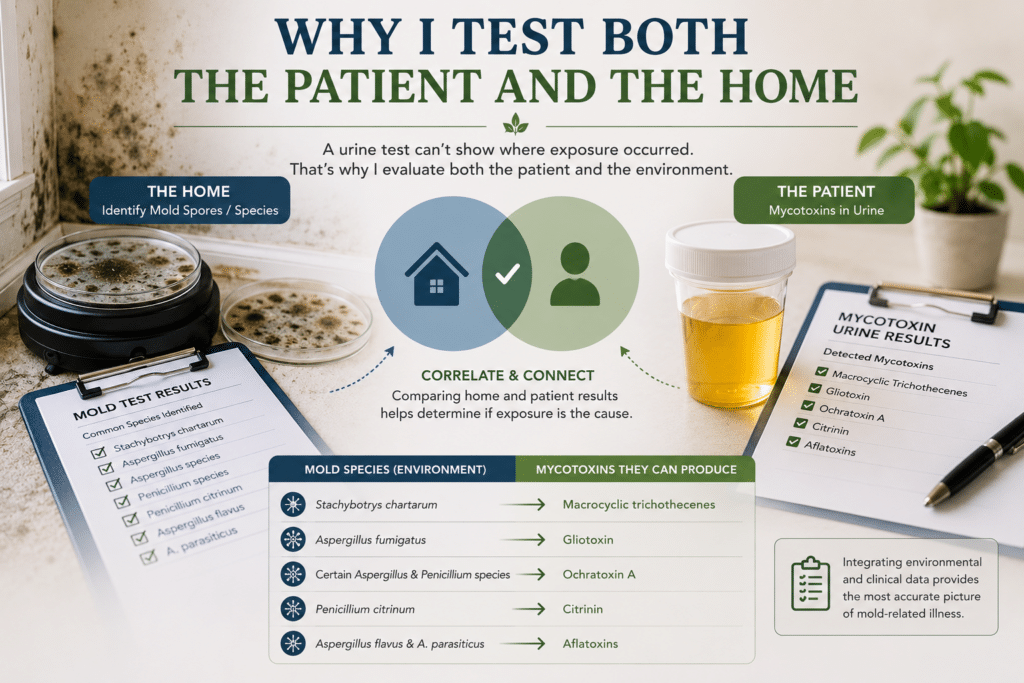
Why I Test Both the Patient and the Home
A urine test cannot show where exposure occurred. For this reason, I often evaluate both the patient and the environment.
I look at the mold spores or species identified in the home and compare them with mycotoxins found in the patient’s urine. For example:
- Stachybotrys chartarum can produce macrocyclic trichothecenes.
- Aspergillus fumigatus can produce gliotoxin.
- Certain Aspergillus and Penicillium species can produce ochratoxin A.
- Penicillium citrinum can produce citrinin.
- Aspergillus flavus and A. parasiticus can produce aflatoxins.[3,6]
The correlation between environmental and clinical findings may help determine whether ongoing exposure warrants further investigation.
RealTime Laboratories EMMA Test
The RealTime Laboratories Environmental Mold and Mycotoxin Assessment, or EMMA, analyzes settled dust for environmental mycotoxins and mold DNA. Its current environmental mycotoxin panel detects 16 mycotoxins, including nine macrocyclic trichothecenes, while its fungal DNA component identifies and quantifies molds associated with mycotoxin production.[12]
Environmental testing should complement, not replace, a detailed inspection for moisture intrusion, leaks, damaged materials, and hidden mold growth.
Other Pieces of the Mold-Illness Evaluation
Mycotoxin testing is only one component of a comprehensive assessment. Depending on the patient, I may also consider:
CIRS Biomarkers
Tests such as TGF-β1, C4a, MMP-9, VEGF, MSH, ADH with osmolality, and VIP are sometimes used within the CIRS framework. These markers do not measure mold or mycotoxins directly, and their clinical interpretation remains debated outside this framework.[8]
MARCoNS
MARCoNS testing uses a nasal culture to look for multiple-antibiotic-resistant coagulase-negative Staphylococcus. Its proposed role in mold-related illness comes primarily from the CIRS model, and evidence supporting routine testing remains limited.
Visual Contrast Sensitivity Testing
Visual Contrast Sensitivity testing measures the ability to distinguish subtle differences in contrast. It may be used as a low-cost screening or monitoring tool within some biotoxin protocols, but an abnormal result is not specific to mold and can occur with eye, neurological, and systemic conditions.
Cross-Contamination After Moving
Leaving a water-damaged building does not always lead to immediate improvement. Symptoms may take time to resolve, and belongings can carry mold spores, fungal fragments, or contaminated dust into a new space.
Porous items including upholstered furniture, mattresses, pillows, books, paper products, carpeting, and some clothing can retain dust. Whether an item can be successfully cleaned depends on the extent of contamination, the material, its condition, and the individual’s sensitivity.
There is no universal rule requiring every porous item to be discarded. Decisions should be based on the severity of contamination, inspection findings, test results, ability to clean the item, and the patient’s health.
How Much Does Mycotoxin Testing Cost?
Mycotoxin test costs vary by laboratory, number of analytes, practitioner fees, and whether environmental or additional specialty testing is ordered. Insurance coverage is inconsistent, and many tests are considered out-of-network.
Because prices and coverage change, patients should confirm the total cost with the laboratory and their healthcare provider before ordering.
Finding Help
Mycotoxin testing can provide valuable information, but it is only one piece of the puzzle. The most meaningful interpretation comes from evaluating test results alongside:
- Symptoms and medical history
- Exposure history
- Home inspection and environmental testing
- Urine mycotoxin results, when appropriate
- Other clinical and laboratory findings
In my practice at The Lyme Specialist, I evaluate both the patient and their environment. Comparing the mold species identified in a home with the mycotoxins detected in urine can help determine whether an ongoing exposure may be contributing to a person’s illness and guide the next steps in treatment.
The goal is to integrate all of the available information to build a complete clinical picture, identify potential sources of exposure, and develop a personalized treatment plan. Working with a certified mold practitioner can help ensure the appropriate testing is selected and that results are interpreted within the context of the individual’s health history and environment.
Mold Is Receiving Increased Attention
The conversation around mold and fungal illnesses is continuing to evolve. On July 30th 2026, the Centers for Disease Control and Prevention (CDC) published one of the first active surveillance studies of invasive mold disease across four U.S. hospitals. In the study, researchers found that invasive mold infections occurred more frequently than previously recognized and were associated with significant illness and mortality in hospitalized patients, particularly among individuals with weakened immune systems. The authors concluded that improved surveillance and greater clinical awareness are needed.16
While this study focused on invasive fungal infections, not chronic exposure to mold in water-damaged buildings or mycotoxin-related illness, it highlights the growing recognition that mold-related health conditions deserve continued research and careful clinical evaluation. As our understanding of fungal diseases expands, clinicians are increasingly recognizing the importance of considering environmental exposures as part of a patient’s overall health assessment.16
References
- Kawamoto M, Page EH; Centers for Disease Control and Prevention. Notes from the Field: Use of Unvalidated Urine Mycotoxin Tests for the Clinical Diagnosis of Illness—United States, 2014. MMWR Morb Mortal Wkly Rep. 2015;64(6):157–158.
- Ediage EN, Di Mavungu JD, Song S, et al. A Direct Assessment of Mycotoxin Biomarkers in Human Urine Samples by Liquid Chromatography Tandem Mass Spectrometry. Anal Chim Acta. 2012;741:58–69.
- Bennett JW, Klich M. Mycotoxins. Clin Microbiol Rev. 2003;16(3):497–516. doi:10.1128/CMR.16.3.497-516.2003.
- World Health Organization. WHO Guidelines for Indoor Air Quality: Dampness and Mould. Copenhagen: WHO Regional Office for Europe; 2009.
- Institute of Medicine. Damp Indoor Spaces and Health. Washington, DC: National Academies Press; 2004.
- Frisvad JC, Hubka V, Ezekiel CN, et al. Taxonomy of Aspergillus, Penicillium, and Related Genera and Their Production of Medically Important Mycotoxins. Stud Mycol. 2019;93:1–63.
- Marin S, Ramos AJ, Cano-Sancho G, Sanchis V. Mycotoxins: Occurrence, Toxicology, and Exposure Assessment. Food Chem Toxicol. 2013;60:218–237.
- Shoemaker RC, House DE. A Time-Series Study of Sick Building Syndrome: Chronic Inflammatory Response Syndrome in Water-Damaged Buildings. Neurotoxicol Teratol. 2006;28(5):573–588.
- RealTime Laboratories. Mycotoxin Panel. Current laboratory test description. Accessed August 2026.
- Mosaic Diagnostics. MycoTOX Profile. Current laboratory test description and practitioner guide. Accessed August 2026.
- Vibrant Wellness. Mycotoxins Test and Total Tox Burden. Current laboratory test descriptions and clinical guidance. Accessed August 2026.
- RealTime Laboratories. Environmental Mold and Mycotoxin Assessment. Current laboratory test description. Accessed August 2026.
- International Agency for Research on Cancer. Aflatoxins. In: Chemical Agents and Related Occupations. IARC Monographs on the Evaluation of Carcinogenic Risks to Humans. Vol. 100F. Lyon: IARC; 2012.
- Pestka JJ. Deoxynivalenol: Mechanisms of Action, Human Exposure, and Toxicological Relevance. Arch Toxicol. 2010;84(9):663–679.
- Hope J. A Review of the Mechanism of Injury and Treatment Approaches for Illness Resulting From Exposure to Water-Damaged Buildings, Mold, and Mycotoxins. ScientificWorldJournal. 2013;2013767482.
- Jackson BR, Benedict K, Lockhart SR, et al. The Epidemiology of Invasive Mold Diseases in the United States: Results of a Population-Based Pilot Surveillance Project. MMWR Suppl. 2026;75(Suppl-5):1-17. doi:10.15585/mmwr.ss7505a1. Available at: https://www.cdc.gov/mmwr/volumes/75/ss/ss7505a1.htm